
Tulum Ruins from Cancún in 2026: The New Fees, the Hours and How to Do It
New July 2026 fees, a site with almost no shade, and a two-hour drive from Cancún — here is how to get the first, quiet hour.
The quick answer: the Tulum ruins from Cancún in 2026
The Tulum ruins are 116 km — about 1 h 45 m — from Cancún Airport and open daily from 8:00 a.m. to about 5:00 p.m. Since July 2026, foreign adults pay 265 pesos for the ruins and the protected area; Mexicans pay 80, free on Sundays. Arrive at 8:00: from about 10:00 the tour buses fill the site.
Three things are worth knowing before you go. The price changed in July 2026, and most websites — including many that rank at the top of Google — still show either 95 or 515 pesos. There is almost no shade, so the first hour is worth more than any other. And you cannot climb anything: Tulum is about the setting, a walled Maya port on a cliff above the Caribbean, not about scaling a pyramid.
This guide covers the new fees and why the old numbers are still everywhere, the hours, measured drive times from Cancún, Playa del Carmen and Puerto Morelos, what you will actually see, and the three best places to add in the same day.
The Tulum ruins in 2026: the numbers
The 2026 fees: what changed in July, and why other guides say 95 or 515 pesos
On 17 July 2026 the Mexican presidency announced a package called Plan Tulum Renace that cut the cost of visiting the Tulum ruins. For foreign visitors, the archaeological zone plus the protected natural area around it now costs 265 pesos. For Mexican nationals it is 80 pesos, and free on Sundays, and the Jaguar Park that now surrounds the site is free for Mexicans. Press reports dated 20 July describe the new rates as in force from that day and through 2027.
That is why the numbers online are such a mess. Three different eras of pricing are still being published:
| Number you will see | What it actually was | Still valid? |
|---|---|---|
| ~95 MXN | The old archaeological ticket on its own, before the Jaguar Park charges existed | No |
| ~515 MXN | 2025 to mid-2026 total for foreigners: roughly 100 ruins + 295 Jaguar Park + 120 conservation bracelet | No — replaced in July 2026 |
| 265 MXN | Current rate for foreign adults (ruins + protected area), announced 17 July 2026 | Yes |
| 80 MXN / free Sunday | Current rate for Mexican nationals | Yes |
One honest caveat. Sources still disagree on the detail inside the 265: some itemise it as 100 pesos for the Jaguar Park, 100 for the ruins and 65 for the national park, while others still mention a separate conservation bracelet of about 120 pesos. Until that settles, budget 265 to 385 pesos per foreign adult, in cash, and read the board at the booth. Children, students, teachers and seniors with Mexican ID can qualify for reduced or free entry to the archaeological zone.
Source for the 2026 rates: the Plan Tulum Renace announcement published by the Presidency of Mexico on gob.mx, 17 July 2026. Fees are set by the authorities and can change — confirm on the day.
Hours, last entry and the best time to arrive
The site opens every day of the year at 8:00 a.m. and closes around 5:00 p.m. Last entry is mid-afternoon — published times range from about 3:30 to 4:30, so treat 4:00 as your deadline.
Be at the gate at 8:00. It is not just the crowds: the paths are exposed limestone and grass with almost no tree cover, and by late morning the heat is the main thing you will remember. Tour buses from Cancún, Playa del Carmen and the cruise ports tend to arrive from about 10:00, and the busiest stretch runs into early afternoon, especially from December to April. From the Cancún Hotel Zone, leaving at about 6:00 puts you there for opening.
Getting to the Tulum ruins from Cancún, Playa del Carmen and Puerto Morelos
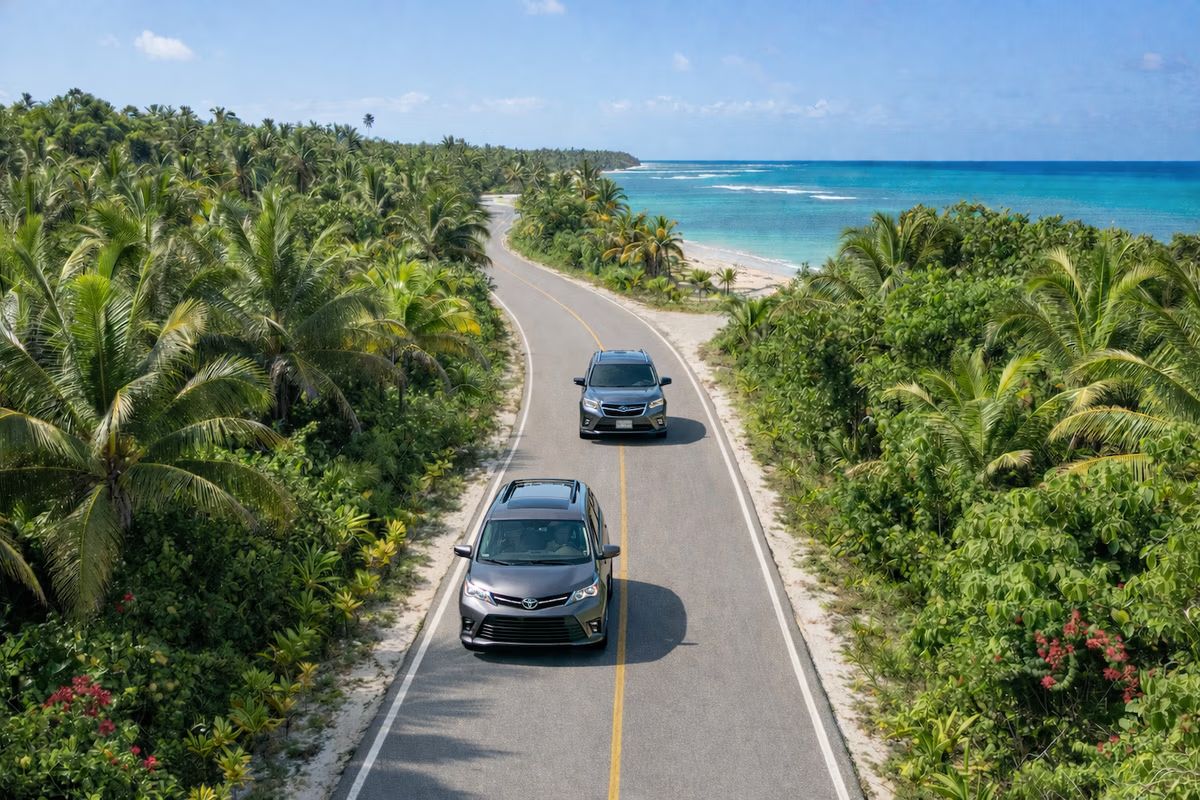
The ruins sit on the coast just north of Tulum town, off Highway 307. These are measured road routes to the archaeological zone:
| From | Distance | Free-flow drive | Plan for | Leave by (to be there at 8:00) |
|---|---|---|---|---|
| Cancún Airport (CUN) area | 116 km | 1 h 34 m | 1 h 45 m – 2 h | 6:00 a.m. |
| Cancún Hotel Zone | 129 km | 1 h 46 m | 2 h – 2 h 15 m | 5:45 a.m. |
| Puerto Morelos | 95 km | 1 h 19 m | 1 h 30 m – 1 h 40 m | 6:20 a.m. |
| Playa del Carmen | 64 km | 51 m | 1 h – 1 h 10 m | 6:50 a.m. |
| Akumal | 25 km | 22 m | 25 – 30 m | 7:30 a.m. |
| Tulum town | 4 km | 9 m | 10 – 15 m | 7:45 a.m. |
Road distances and free-flow times calculated on OpenStreetMap data. “Plan for” is what we schedule against after 33 years on Highway 307.
Private tour or transfer. The simplest way from Cancún: picked up at your hotel, dropped at the access, collected when you are done. Our Tour Express Tulum is exactly that — private transport, bilingual driver, entrance to the ruins and water included, and you set the start time. ADO bus. The cheapest option: ADO runs from downtown Cancún and Playa del Carmen to Tulum, roughly 2 to 2.5 hours from Cancún, then a short taxi or colectivo ride to the ruins. The first buses rarely get you there for opening. Rental car. An easy drive; expect paid parking near the access.
Staying in Tulum rather than visiting for the day? Our Cancún Airport to Tulum guide compares every way to get there with luggage.
What you will see at the Tulum ruins
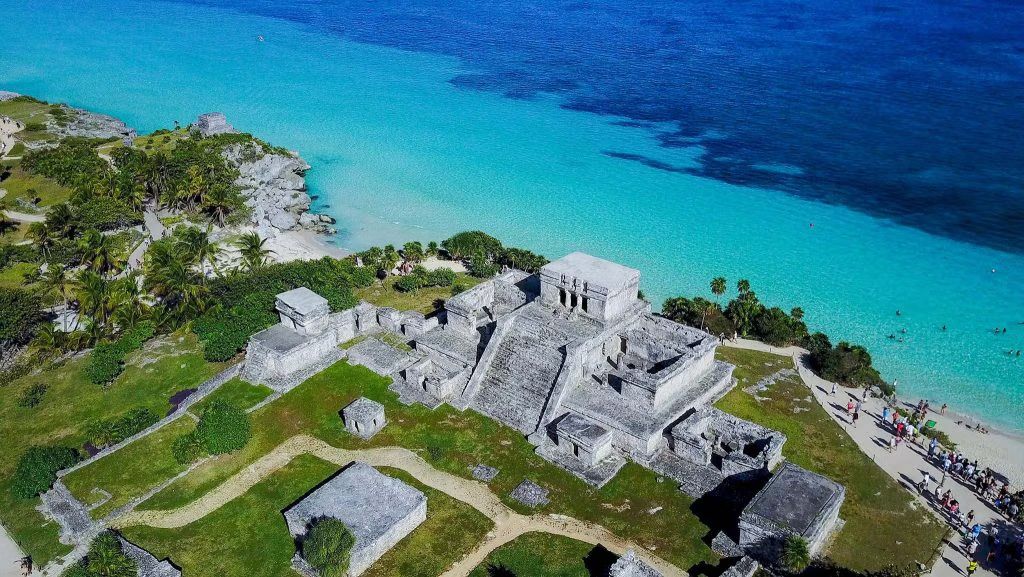
Tulum was a walled Maya port, and its ancient name is usually given as Zamá, “dawn” — fitting for a city facing east over the sea. It flourished in the late Postclassic period, roughly the 13th to 16th centuries, and was still inhabited when the first Spanish ships sailed along this coast in 1518. The word tulum means “wall”, and the stone wall that encloses the city on three sides is the first thing you walk through.
El Castillo. The largest building, on the cliff edge, and the one in every photograph. It likely served partly as a landmark for canoes finding the gap in the reef below.
The Temple of the Frescoes. A two-level building with traces of painted murals inside and carved figures on its corners. You view it from outside.
The Temple of the Descending God. Named for the upside-down winged figure above its doorway, a motif that appears across the site.
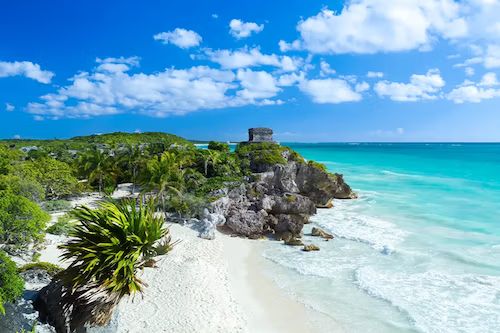
The Temple of the Wind God. A small temple on a rocky point above a cove, and the classic postcard view looking back from the beach side.
The beach below the cliff. A wooden staircase leads down to a small beach inside the site. It is usually open for swimming, but it can close for sargassum or turtle nesting — treat it as a bonus.
Tulum is compact: about 1.5 to 2 hours covers it well, including the walk in from the access. Since the area became part of the Jaguar Park, that walk is longer than it used to be; a small shuttle sometimes runs for a fee, but plan to walk.
Tulum plus one more stop: Cobá, Gran Cenote or Akumal
Because the ruins take only a couple of hours, most people pair them with something else. Three combinations work well, each for a different kind of day:
| Pair Tulum with | Distance from the ruins | What it adds | Best for |
|---|---|---|---|
| Gran Cenote | ~10–15 min | A clear cavern cenote with freshwater turtles | A hot day and a swim after the ruins |
| Akumal | 25 km, ~22 min | Snorkelling with wild green sea turtles | Families and first-time snorkelers |
| Cobá | ~45 min inland | A jungle city and the tall Nohoch Mul pyramid | History lovers who want a second, very different site |
Our guides go deeper on each: Gran Cenote (500 pesos, the sunscreen rule and the best hour), Akumal’s sea turtles (the guide, life jacket and no-fins rules), and Cobá. Whichever you choose, do the ruins first at 8:00 — the second stop suffers far less from the midday heat and crowds.
What to bring
Pesos in cash in small bills, for entry, parking and water. A hat, water and sun protection — there is very little shade. Comfortable shoes for the walk in and the uneven paths. A swimsuit and towel if you want the beach, and reef-safe sunscreen if you plan to swim.
Leave the drone at the hotel. Drones and professional filming kit such as tripods need a permit at Mexico’s archaeological sites; phones and normal cameras are fine.
Frequently asked questions
How much is the entrance fee to the Tulum ruins in 2026?
Under the rates the Mexican government announced on 17 July 2026, foreign adults pay 265 pesos for the archaeological zone and the protected natural area, and Mexican nationals pay 80 pesos, free on Sundays. Reports still differ on whether a separate conservation bracelet of around 120 pesos is charged on top, so budget 265 to 385 pesos per foreign adult, in cash, and check the board at the ticket booth.
Why do other websites say the Tulum ruins cost 95 or 515 pesos?
Because they are out of date in two different ways. Around 95 pesos was the old archaeological ticket on its own, before the Jaguar Park fees were added. About 515 pesos was the combined total foreign visitors paid from 2025 until the July 2026 cut, when the park and conservation charges were stacked on top. Neither is the current price.
What are the Tulum ruins opening hours?
The archaeological zone opens every day at 8:00 a.m. and closes around 5:00 p.m. Last entry is mid-afternoon, around 4:00 p.m.; sources vary between about 3:30 and 4:30, so do not arrive late. The first hour after opening is the coolest and the quietest.
How far are the Tulum ruins from Cancún?
About 116 kilometres from Cancún Airport, roughly 1 hour 45 minutes to 2 hours by road, and about 129 kilometres from the Hotel Zone, around 2 hours to 2 hours 15 minutes. From Playa del Carmen it is 64 kilometres and about an hour, and from Tulum town only 4 kilometres. From Cancún it is a full morning or a day trip, not a quick stop.
What is the best time to visit the Tulum ruins?
At 8:00 a.m., when the gates open. There is very little shade on the site, it gets hot quickly, and tour buses from Cancún and Playa del Carmen tend to arrive from about 10:00, with the busiest stretch until early afternoon, especially from December to April. Leaving the Hotel Zone around 6:00 gets you there for opening.
How long do you need at the Tulum ruins?
Plan about 1.5 to 2 hours to walk the site, including the walk in from the entrance. Add an hour if you want to swim at the beach below the cliff. Tulum is compact compared with Chichén Itzá or Cobá, which is why it pairs so well with a second stop the same day.
Can you climb the pyramid at Tulum?
No. El Castillo and the other buildings are roped off to protect them, and you view them from the paths. If climbing a pyramid matters to you, Cobá's Nohoch Mul, about 45 minutes inland, is the one to look at; our Cobá guide covers the current situation there.
Can you swim at the beach at the Tulum ruins?
Usually yes. A wooden staircase leads down to a small beach below the cliffs, inside the site, so only ticket holders can reach it. It is occasionally closed, for example during heavy sargassum or turtle nesting, so treat it as a bonus rather than the plan. Bring a swimsuit and a towel.
Do I need a guide at the Tulum ruins?
No, you can walk it on your own; the signs are basic, though. Licensed guides offer tours at the entrance, and a good one brings the history of the walled port to life in about an hour. If you are going with TT & More, your driver will drop you at the access and meet you when you are done.
Can I pay by card at the Tulum ruins?
Do not count on it. Card terminals exist at some booths but connections fail often, and parking and small vendors are cash only. Bring enough pesos in small bills to cover entry for everyone, parking and water.
Can I visit the Tulum ruins and a cenote in one day?
Yes. Gran Cenote is about 10 to 15 minutes from the ruins by road, and Akumal Bay, where you can snorkel with sea turtles, is 25 kilometres or about 22 minutes north. TT & More runs private day tours for Tulum with Gran Cenote, with Akumal, and with Cobá.
Are drones allowed at the Tulum ruins?
Not without a permit. Drones, and professional filming equipment such as tripods, need authorisation at Mexico's archaeological sites. Phone cameras and ordinary cameras are fine.