
Cenote Ik Kil from Cancún: How to Visit in 2026
Prices, opening hours, the new CATVI entrance rule at Chichén Itzá, and the timing that decides your whole day.
The quick answer: visiting Cenote Ik Kil from Cancún
Cenote Ik Kil is an open-air sinkhole 3 km east of Chichén Itzá, about 195–200 km and 2.5–3 hours from Cancún. Entry runs roughly 150–250 MXN per adult in 2026, cash pesos only, and it opens daily from around 9:00 a.m. to 5:00 p.m. The water sits 26 metres below the rim, the pool is about 60 metres across and 40 metres deep, and it stays at 24–26 °C all year.
That distance is the whole story. Ik Kil is not a Cancún excursion you slot into an afternoon — it is a full day, five to six hours of driving round trip, and virtually everyone sees it on the same trip as Chichén Itzá.
Two things changed in 2026 that most guides have not caught up with, and both affect how you plan the day: Chichén Itzá can now only be entered through its new CATVI visitor centre, and the ruins now close at 4:00 p.m. with last access at 3:00 p.m. Ik Kil stays open later. Get that order wrong and you drive five hours to stand at a closed gate.
What changed in 2026: Chichén Itzá now has one entrance
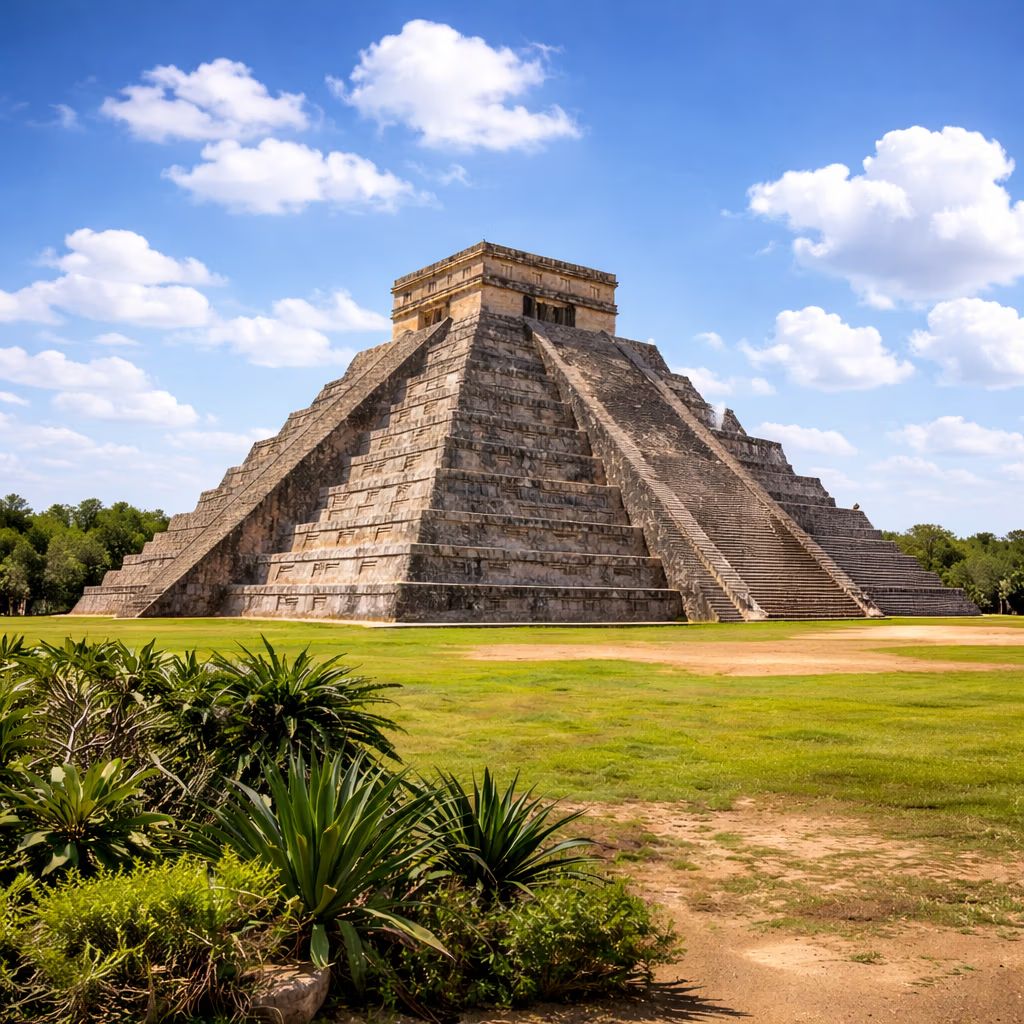
In late May 2026 Chichén Itzá closed to the public for 13 days. It was not damage or conservation work — it was a dispute over relocating more than 600 vendors, artisans and guides into CATVI, a new 16-hectare visitor complex with 962 commercial spaces that INAH's director described as the largest visitor-services infrastructure in Latin America. The site reopened on 1 June 2026, and access is now exclusively through CATVI rather than the several informal entrances that existed before.
For a visitor, three practical consequences:
What the CATVI change means for your day
Four ways to get from Cancún to Cenote Ik Kil
There is no direct public transport to the cenote gate. Every option below ends with the same three-kilometre hop from Chichén Itzá or Pisté, and that last leg is where independent trips usually come apart.
| Option | Typical cost | Time each way | Honest verdict |
|---|---|---|---|
| Private tour (door to door) | Flat vehicle rate, 1–9 passengers | 2.5–3 h | You control the timing, which is the one thing that decides whether Ik Kil is magical or a queue. Best from 3–4 people up. |
| Shared coach tour | Per seat | 3–4 h with pickups | Cheapest for one or two people. You arrive at the cenote at peak hour with everyone else, and you leave when the bus leaves. |
| ADO bus + taxi | Bus per seat, then a local taxi for the last 3 km | 3–4.5 h | Doable but tight. Buses to Pisté are limited, and the return timetable, not your plans, sets your departure. |
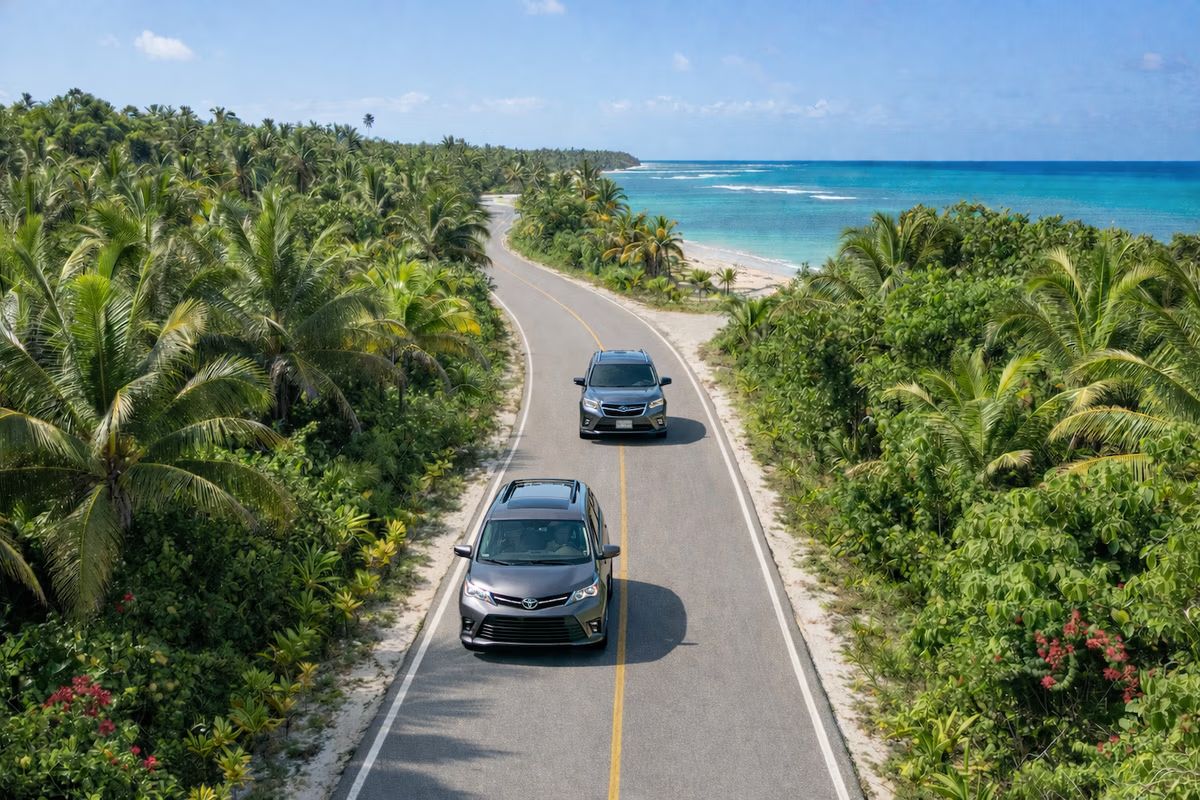
| Rental car | Rental + fuel + 180D tolls + parking | 2.5 h | Full freedom, but the 180D tolls on this route are steep and you will be driving five to six hours on the day you also want to swim. |
The pattern is the same one that governs every trip out of Cancún: seats are priced per person, vehicles are priced per vehicle. Two travellers should almost always take a shared tour. A family of five is usually better off in one private vehicle — and gets to swim at 9:30 a.m. instead of noon. We break the same maths down in detail in our guide to the best Chichén Itzá tours from Cancún and, for larger parties, Chichén Itzá transport for groups.
Prices, hours and what your Ik Kil ticket covers
Here we are going to do something the other guides do not: tell you that the published numbers disagree with each other.
Entry-only rates quoted for 2026 range from about 150 to 250 Mexican pesos per adult, with children roughly half. Packages that include the on-site buffet restaurant are quoted around 500 pesos. Opening hours are variously listed as 8:00 a.m.–5:00 p.m., 9:00 a.m.–5:00 p.m. and 8:00 a.m.–6:00 p.m.
Every one of those sources is confident and several are recent. Ik Kil is privately operated and adjusts its rates without announcing them, so any single figure you read online — including ours — is a snapshot. Plan on 250 pesos a head, bring cash in pesos, and treat 9:00 a.m. to 5:00 p.m. as the safe window. You will never be caught short.
What the ticket normally covers: the stone staircase down to the water platform, the jumping platforms, changing rooms, showers and use of a life jacket. Lockers are extra, usually 30–50 pesos. There is a restaurant and a set of cabañas on site.
Cash, pesos, only. There are no card machines at the gate. The nearest ATMs are in Pisté village about a kilometre away, and they are not always working. This catches out more visitors than anything else on this page.
What Cenote Ik Kil is actually like
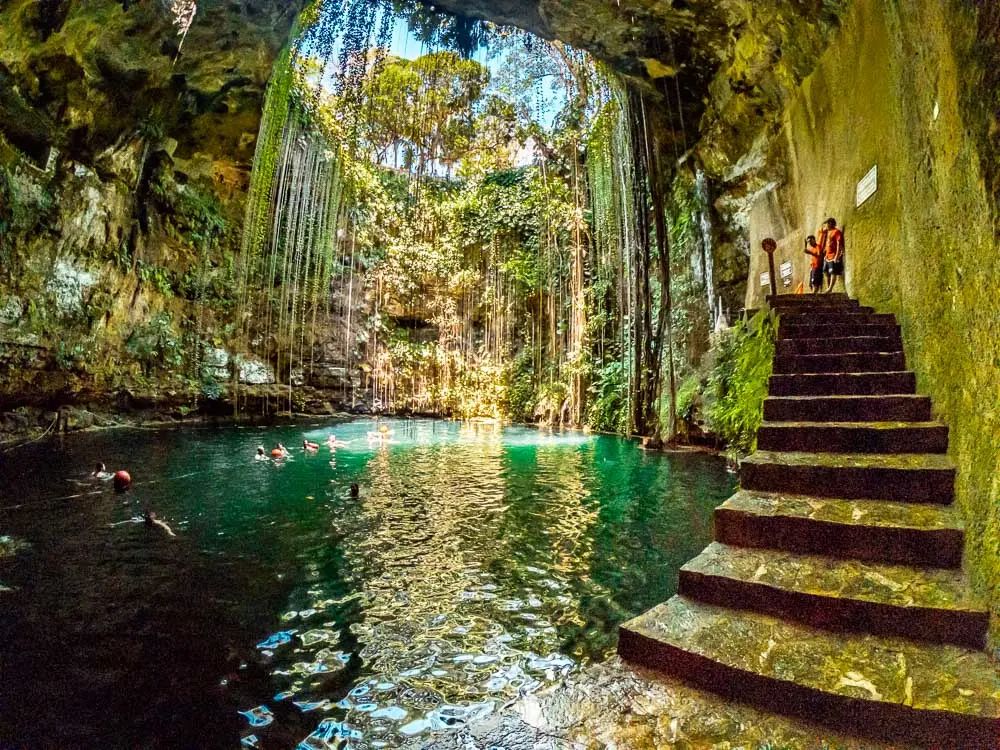
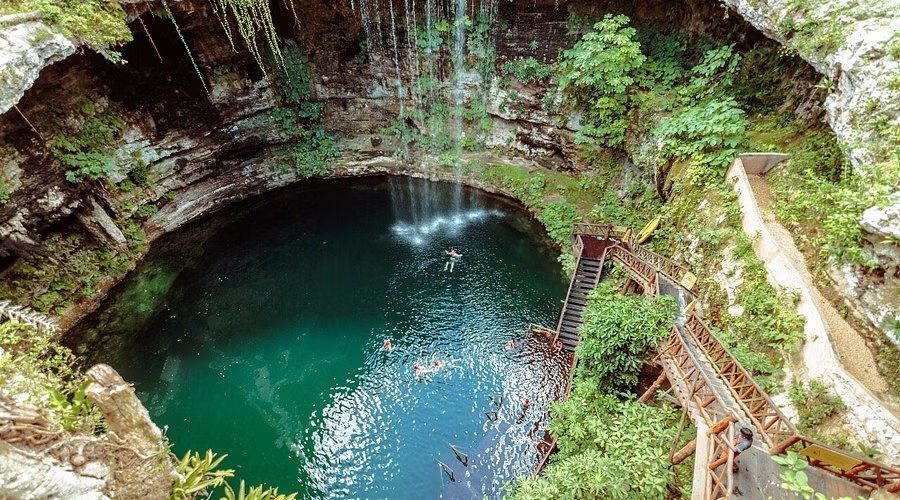
Ik Kil is an open cenote: the limestone roof collapsed long ago, so you look down into a near-perfect circular shaft rather than into a cave. The rim is ringed with vegetation and the walls are curtained with tree roots that hang the full 26 metres to the water. Thin waterfalls trickle down the sides. At midday the sun drops straight through the opening and lights the pool from directly above, which is why you have seen this cenote a hundred times without knowing its name.
The numbers: about 60 metres across, the water surface 26 metres (85 ft) below the rim, and roughly 40 metres (130 ft) deep at the centre. Water temperature holds at 24–26 °C (75–79 °F) year-round, which feels sharply cold for the first ten seconds after the Yucatán heat and perfect thereafter.
You descend a carved stone staircase through a tunnel in the rock to a wooden platform at water level. From there you can lower yourself in, or use the jumping platforms above. Small black catfish circle just under the surface — harmless, and the reason a mask is worth packing.
It is beautiful, and it is busy. Being honest about both is the point of this guide.
The rules the staff actually enforce
Cenotes are the visible openings of the Yucatán's underground freshwater system — the peninsula has almost no surface rivers, and this is the water table. That is why the rules exist and why they are not decorative.
Before you get in the water
The timing window that decides your whole day
This is the part worth reading twice, because it is where independent day trips fail.
Chichén Itzá now closes at 4:00 p.m. with last access at 3:00 p.m. Ik Kil closes around 5:00 p.m. Cancún is 2.5 to 3 hours away. Work backwards and the day only fits one way round:
| Time | Where you should be | Why |
|---|---|---|
| 6:30–7:30 a.m. | Leaving Cancún | The only departure window that gets you to the ruins before the heat and the coaches. |
| 9:30–10:00 a.m. | Entering Chichén Itzá via CATVI | Well inside last access, and the site is at its quietest and coolest. |
| 12:00–1:00 p.m. | Finishing at the ruins | Roughly two hours is enough to walk the site properly. |
| 1:00–3:00 p.m. | Cenote Ik Kil | Five minutes away. Peak crowd, but the light through the opening is at its best. |
| Better, if you can choose | Ik Kil at 9:00 a.m., ruins after | Nearly empty cenote. Only works if your transport is yours to direct. |
| 4:00–5:00 p.m. | Driving back | Home in Cancún by 7:00–8:00 p.m. |
Notice what the last two rows really say. The single biggest quality difference between one Ik Kil visit and another is not the ticket price — it is whether you arrive at 9:00 a.m. or at noon. A coach tour cannot give you that choice, because it has forty other people's schedules to serve. That is the honest case for a private Chichén Itzá and Cenote Ik-Kil tour, and it has nothing to do with luxury.
Ik Kil or a different cenote? An honest comparison
Ik Kil is the famous one, not automatically the right one. If your priority is swimming rather than photographs, one of these may suit you better — and several sit on the same day trip.
| Cenote | Type | Near | Best for |
|---|---|---|---|
| Ik Kil | Open, 26 m drop | 3 km from Chichén Itzá | The iconic shot, first-timers, non-swimmers. Busiest 11 a.m.–2 p.m. |
| Selva Maya | Open, landscaped | Pisté, by Chichén Itzá | The same day trip with noticeably fewer people and better facilities. |
| X'Canché | Open, jungle | Ek Balam | Pairing a swim with a pyramid you are still allowed to climb. |
| Gran Cenote | Semi-open, cavern | Tulum | Snorkelling, turtles and stalactites. A different trip entirely. |
| Yokdzonot area | Open, community-run | On the Cobá route | Travellers who want the quietest option and to keep money local. |
If you only have one day and want the postcard, take Ik Kil. If you have already seen it, or you are travelling in August when the coach volume peaks, Cenote Selva Maya gives you the same swim in the same afternoon with a fraction of the crowd.
Tour or independent? A straight answer
One or two people: take a shared tour. Splitting a coach forty ways is unbeatable on price, and the compromise — arriving at the cenote at peak hour — is a fair trade for the saving.
Three or more, or travelling with kids or grandparents: price a private vehicle. A flat rate covering 1 to 9 passengers stops scaling the moment your third traveller boards, and you gain the early start, the air conditioning, the ability to leave when you have had enough, and no 6:00 a.m. hotel-to-hotel pickup loop.
Genuinely independent: possible, cheapest on paper, hardest to execute. The ADO network reaches Pisté but on a thin timetable, and you still need a taxi for the last three kilometres in each direction. Give yourself a fallback plan before you commit.
Whichever you choose, our full breakdown of Cancún to Chichén Itzá transportation covers the routes, tolls and drive times in detail.
Your Cenote Ik Kil checklist
Frequently asked questions
Where is Cenote Ik Kil and how far is it from Cancún?
Cenote Ik Kil is in Tinum, Yucatán, about 3 kilometres east of the Chichén Itzá archaeological zone — roughly a five-minute drive. From Cancún it is about 195 to 200 kilometres, or 2.5 to 3 hours each way on the 180D toll road. That distance is the single most important fact about Ik Kil: it is not a Cancún day at the beach, it is a full day out, and almost everyone visits it on the same trip as Chichén Itzá.
How much does it cost to enter Cenote Ik Kil in 2026?
Published rates disagree, which is worth knowing before you arrive. Entry-only prices quoted for 2026 range from about 150 to 250 Mexican pesos per adult, and packages that bundle the on-site buffet run higher, around 500 pesos. Children are usually about half price. Ik Kil takes cash in Mexican pesos only — there are no card machines at the gate — so bring more pesos than you think you need. The nearest ATMs are in Pisté village, about a kilometre away.
What are Cenote Ik Kil's opening hours?
Ik Kil opens daily in the morning and closes in the late afternoon, but the exact times quoted by different sources vary between an 8:00 or 9:00 a.m. opening and a 5:00 or 6:00 p.m. close. Plan around a 9:00 a.m. to 5:00 p.m. window and assume last entry is roughly 30 minutes before closing, and you will not get caught out. If you are combining it with Chichén Itzá, the ruins are the tighter constraint anyway — see the timing section above.
How deep is Cenote Ik Kil?
About 40 metres, or 130 feet, at the centre. The water surface sits roughly 26 metres — 85 feet — below the rim, and the circular opening is around 60 metres across. You swim at the surface, so the depth is not something you experience directly, but it is why life jackets are handed out and why non-swimmers are fine here. The water stays between about 24 and 26 °C, roughly 75 to 79 °F, all year.
Do I need to know how to swim to visit Cenote Ik Kil?
No. Life jackets are provided at the cenote and non-swimmers are expected to wear them. There is a carved stone staircase down to a wooden platform at water level, so you can enter gradually rather than jump. The jumping platforms above the water are entirely optional and plenty of visitors never use them. Bring a mask if you want to look down into the water — there are small black catfish just below the surface.
Can I wear sunscreen at Cenote Ik Kil?
Not chemical sunscreen — it is banned, and you will be asked to rinse off in the showers before you are allowed into the water. Cenotes feed the Yucatán's underground freshwater system, and sunscreen, insect repellent and body lotion all damage it. Either use a genuinely biodegradable, reef-safe product well before you arrive, or do what most regulars do: skip sunscreen for the swim, and cover up with a rash guard and a hat instead.
Is Cenote Ik Kil crowded, and when is the best time to go?
It is the most visited cenote in the Yucatán interior, and it gets genuinely packed between roughly 11:00 a.m. and 2:00 p.m., when the big coach tours arrive from Cancún and Playa del Carmen after finishing at Chichén Itzá. Go first thing in the morning or after about 3:00 p.m. and the same cenote feels like a different place. This is the main practical advantage of a private tour: you choose the order of the day, so you can swim before the buses land.
Do I need to visit Chichén Itzá to see Cenote Ik Kil?
No — they are separate sites with separate tickets, and you can visit Ik Kil on its own. In practice almost nobody does, because they are three kilometres apart and both are 2.5 hours from Cancún. If you are making that drive, it makes sense to do both. Just be aware that since June 2026 Chichén Itzá can only be entered through its new CATVI visitor centre, and the ruins close earlier than the cenote does.
What changed at Chichén Itzá in 2026?
Chichén Itzá closed for 13 days in late May 2026 during a dispute over relocating more than 600 vendors and artisans into CATVI, a new 16-hectare visitor complex. It reopened on 1 June 2026, and access is now exclusively through CATVI rather than the old entrances. Practically, that means one controlled entry point, a single ticketing flow, and a walk or shuttle from the complex to the ruins — so build in extra time at the start of your visit.
Is it cheaper to visit Cenote Ik Kil on a tour or independently?
For one or two people, a shared coach tour is usually the cheapest way to see Ik Kil and Chichén Itzá together, because the cost of the vehicle is split across a full bus. From three or four people upward, a private tour starts to compete, because it is priced per vehicle rather than per seat — and it buys you the thing that actually matters here, which is control of the timing. Going fully independently by bus is the cheapest on paper but the hardest to make work in one day.