
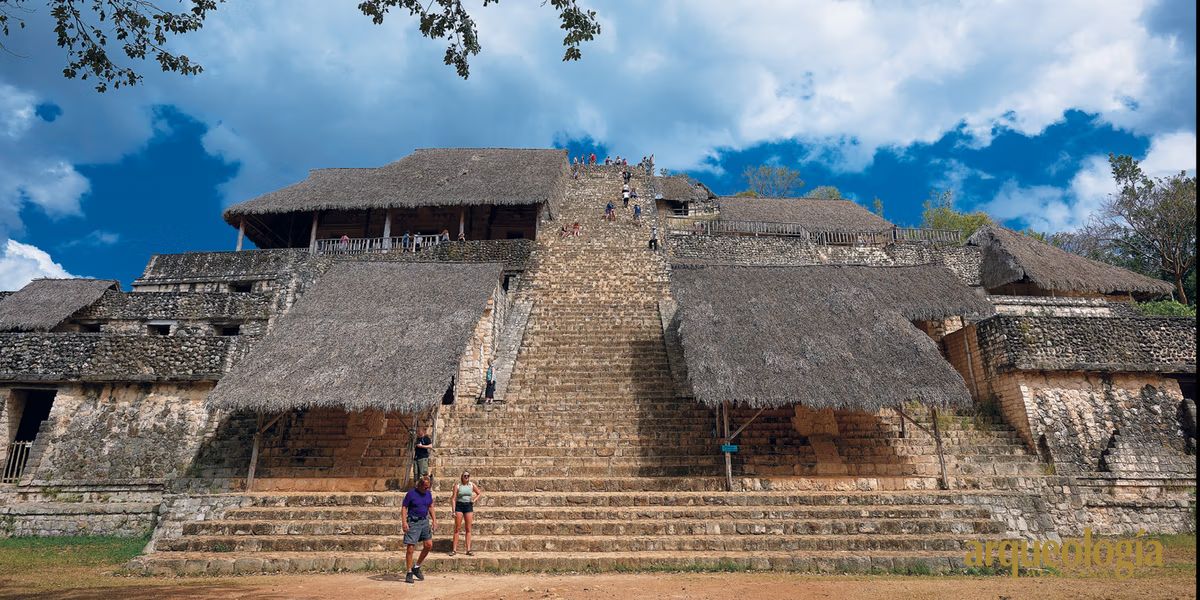
Ek Balam and Cenote X'Canché in 2026: The Tallest Pyramid You Can Still Climb
43 metres, original stone steps and a rope — plus the best-preserved stucco frieze in the Maya world, and a cenote 1.5 km away.
The quick answer: Ek Balam and Cenote X'Canché in 2026
Ek Balam is a Maya city 17 km north of Valladolid and about two hours from Cancún, and its main pyramid — the Acropolis — is 43 metres tall and still open to climb. Entry in 2026 is 691 MXN for a foreign adult, the site runs 8:00 a.m. to 5:00 p.m. with last entry at 4:00 p.m., and Cenote X'Canché sits 1.5 km away for a separate 90 MXN.
Two things surprise almost everyone who goes. The first: the Acropolis is taller than both Nohoch Mul at Cobá (42 m) and El Castillo at Chichén Itzá (30 m) — Ek Balam has the tallest structure of the three sites people actually choose between, and it is barely known.
The second is less welcome: Ek Balam is not the cheap alternative. At 691 MXN it costs essentially the same as Chichén Itzá (697 MXN) and more than double Cobá (330 MXN). It is quiet, not budget. Worth knowing before you plan a day around it.
Which Yucatán pyramids can you actually climb in 2026?
This question changed recently and most guides online have not caught up. Cobá reopened its pyramid to climbers on 8 December 2025 after six years closed, which means there are now two climbable options rather than one. Plenty of articles still say Ek Balam is the only one left. That is out of date.
| Ek Balam | Cobá | Chichén Itzá | |
|---|---|---|---|
| Climb it? | Yes | Yes, since Dec 2025 | No |
| Height | 43 m | 42 m | 30 m |
| What you climb | Original uneven stone steps, thick rope down the centre | New wooden staircase with handrail | — |
| Entry 2026 | 691 MXN | 330 MXN | 697 MXN |
| From Cancún | ~2 h | ~2 h | ~2 h 30 m |
| Crowds | Lightest of the three | Light | Very heavy after 10 a.m. |
| The reason to go | The stucco frieze, and a climb that feels genuinely old | Jungle, bikes, an easier climb | The Wonder of the World |
If you want to climb and you are travelling with children, older relatives, or anyone uneasy on steps, Cobá is the kinder climb — purpose-built stairs with a handrail. If you want the raw version, on the original stonework, Ek Balam is it. Our full write-up on the other one is here: Cobá ruins and the pyramid you can climb again.
Climbing the Acropolis: what it is actually like
The Acropolis is a broad, terraced platform rather than a single steep cone, and the ascent is about 120 original stone steps — uneven, worn, and noticeably deeper on some rows than others. A thick rope runs down the centre and most people use it on the way up and rely on it on the way down.
It is a moderate climb, not a technical one, but it is honest to say it suits some people and not others. If you have knee trouble, real vertigo, or you are carrying a toddler, this is the one to think twice about. There is no lift, no alternative route, and the descent is the part people underestimate.
What you get at the top is a flat green horizon of jungle in every direction, with the tops of other structures poking through and, on a clear day, no other ruin in sight. It is unusually quiet up there because so few people come.
El Trono: the reason to come even if you never climb
Part way up the Acropolis, on a terrace you pass on the ascent, is the entrance to a tomb known as El Trono — the Throne. It is framed by an enormous stucco jaguar mouth, teeth and all, flanked by figures with what look like wings, and it is one of the best-preserved Maya stucco reliefs anywhere.
It survived because it was deliberately buried: the Maya sealed the chamber under rubble and fill, which protected the plasterwork from a thousand years of weather. Nothing at Chichén Itzá or Cobá comes close for surface detail, and you stand right in front of it rather than behind a rope at a distance.
Ek Balam means “black jaguar” in Yucatec Maya, and the frieze is the clearest reason the name stuck.
Cenote X'Canché
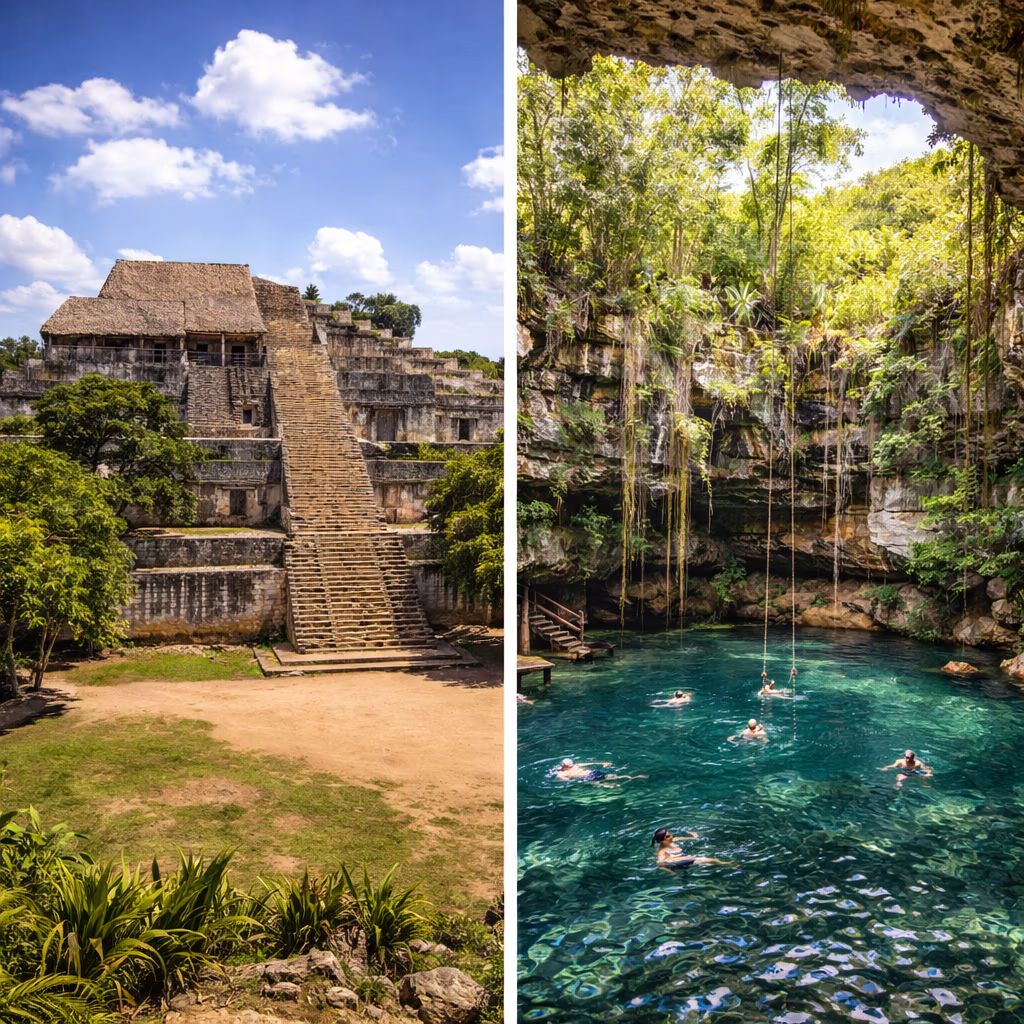
About 1.5 km from the ruins sits Cenote X'Canché, an open-air sinkhole roughly 25 metres deep with vines hanging to the water. It is run as a community project by the local ejido, and entry is 90 MXN on top of your ruins ticket.
Getting there is part of the fun: it is a 25 to 30 minute walk on a shaded jungle path, or you can hire a trike for about 70 MXN return at the trailhead — a three-wheeled bicycle with a bench, pedalled by a local driver. There are changing rooms and basic lockers, plus rope swings and a zipline if you want them.
Practical order: ruins first, cenote second. You will be hot after the climb, the site takes last entries at 4:00 p.m., and there is no version of this day where swimming first improves it.
Ek Balam in 2026: the numbers
How far is Ek Balam, and how do you get there?
Ek Balam sits deep in Yucatán state, closer to Valladolid than to anywhere on the coast. Most guides therefore tell you to base yourself in Valladolid — which is genuinely good advice if you are backpacking, and useless if you have already booked a hotel in Cancún.
| From | Distance | Drive time each way | Realistic day |
|---|---|---|---|
| Valladolid | 17 km | 20–25 min | Half day |
| Tulum | ~130 km | ~1 h 30 m | 7–8 hours |
| Cancún | ~165 km | ~2 h | 9–10 hours |
| Playa del Carmen | ~150 km | ~1 h 50 m | 8–9 hours |
There is no direct bus to the Ek Balam gate. Independently from the coast the route is an ADO to Valladolid, then a colectivo or taxi for the last 17 km — workable, but it puts you at the ruins late morning at the earliest, which is exactly when the climb stops being enjoyable.
From Cancún the realistic options are a private vehicle, an organised tour, or a rental car. A private transfer is the only one that lets you leave at 6:00 a.m. and have the Acropolis effectively to yourself, and because the rate is per vehicle rather than per seat, it usually beats tour pricing from about three passengers up.
Ek Balam with Chichén Itzá, or on its own?
The two sit about 50 minutes apart, so pairing them in one day is common and TT & More runs exactly that combination. It is a long day — expect 11 to 12 hours from Cancún — but it works because the sites are so different in character: one monumental and busy, the other quiet and hands-on.
The sequencing matters more than people expect. Do Ek Balam first. The climb is the physical part of the day and you want it early, before the heat; Chichén Itzá is flat walking and holds up better in the afternoon. Doing it the other way round means climbing 43 metres of uneven stone at 2 p.m. in the sun, which is how a good day turns into a bad one.
If you would rather not spend twelve hours out, Ek Balam plus Cenote X'Canché on its own is a comfortable, unhurried day and leaves you time for Valladolid on the way home.
Which option fits which traveller
| You are… | Best choice | Why |
|---|---|---|
| Based in Cancún or the Riviera Maya | Private transfer or tour | No direct bus, ~2 hours each way, and an early start is what makes the climb worth doing. |
| Backpacking, flexible | Overnight in Valladolid | 17 km away, colectivos run, and you reach the gate at opening for a fraction of the cost. |
| Want to climb, but nervous on steps | Cobá instead | New wooden staircase with a handrail, half the entry price, and an easier day overall. |
| Have already seen Chichén Itzá | Ek Balam + X'Canché | The frieze and the climb are the two things Chichén Itzá cannot give you. |
| Only one day, want maximum ruins | Ek Balam + Chichén Itzá | Fifty minutes apart. Long day, but the two complement each other well — Ek Balam first. |
| Travelling with young children | Cobá, or Ek Balam without the climb | El Trono is on a lower terrace, so the best thing at Ek Balam does not require the full ascent. |
What to bring
Cash in pesos for the two fee windows, parking, the cenote and the trike. Closed shoes with grip — the stone steps are worn smooth in places and sandals are a genuinely bad idea here. Plus sun protection you can reapply, insect repellent, more water than feels necessary, and a swimsuit and towel for X'Canché. There is very little shade on the site itself.
Frequently asked questions
Can you still climb the pyramid at Ek Balam in 2026?
Yes. The Acropolis remains open to climbers, up roughly 120 original stone steps with a thick rope running down the centre for handholds. It is one of two major Yucatán pyramids you can currently climb — Cobá reopened its own on 8 December 2025 — while Chichén Itzá and Uxmal remain closed to climbing. Access can be suspended in heavy rain, and closed shoes with grip are strongly advised.
How much does it cost to enter Ek Balam?
In 2026 a foreign adult pays 691 MXN in total: a 210 MXN federal INAH fee plus a 481 MXN Yucatán state CULTUR fee, charged at two separate windows. Mexican nationals pay about 237 MXN and Yucatán residents 105 MXN, both with original identification. Parking is a further 100 MXN, and Cenote X'Canché is 90 MXN on top. Bring pesos in cash.
Is Ek Balam cheaper than Chichén Itzá?
No, and this catches a lot of people out. At 691 MXN Ek Balam costs almost exactly the same as Chichén Itzá at 697 MXN, and more than twice as much as Cobá at 330 MXN. What you are paying for at Ek Balam is not a discount but the quiet, the stucco frieze, and the fact that you can climb.
How tall is the Ek Balam pyramid?
The Acropolis stands 43 metres, about 141 feet, which makes it taller than Nohoch Mul at Cobá (42 m) and considerably taller than El Castillo at Chichén Itzá (30 m). It is the tallest structure of the three Yucatán sites most visitors choose between, which is surprising given how few people have heard of it.
What is the stucco frieze at Ek Balam?
Part way up the Acropolis is the entrance to a tomb called El Trono, framed by a huge stucco jaguar mouth complete with teeth and flanked by winged figures. It survived because the chamber was deliberately buried in antiquity, protecting the plaster from weather, and it is among the best-preserved Maya stucco reliefs in existence. You view it at close range on the terrace, so you do not need to complete the full climb to see it.
How far is Ek Balam from Cancún?
About 165 kilometres, roughly two hours each way by road, making it a 9 to 10 hour day in total. There is no direct bus to the site: independently you would take an ADO to Valladolid and then cover the last 17 kilometres by colectivo or taxi. From Cancún the practical choices are a private transfer, an organised tour, or a rental car.
What is Cenote X'Canché and how do you get to it?
X'Canché is an open-air cenote about 25 metres deep, roughly 1.5 kilometres from the ruins and run as a community project by the local ejido. Entry is 90 MXN. You can walk the shaded jungle path in 25 to 30 minutes, or hire a pedal-powered trike with a driver for about 70 MXN return. There are changing rooms and basic lockers, plus rope swings and a zipline. Visit it after the ruins, not before.
Can you visit Ek Balam and Chichén Itzá in the same day?
Yes — they are about 50 minutes apart and the combination is a common day trip, though from Cancún it runs 11 to 12 hours. Do Ek Balam first: the climb is the physically demanding part and it is far better done in the cool of the morning, whereas Chichén Itzá is flat walking that holds up fine in the afternoon.
Ek Balam or Cobá — which is the better climb?
Cobá is the easier and cheaper climb: a new wooden staircase with a handrail, installed in December 2025, and 330 MXN entry. Ek Balam is the more atmospheric one, on original uneven stonework with a rope, and it is a metre taller. For families, older travellers or anyone uncertain on steps, choose Cobá. For the stucco frieze and the sense of climbing something genuinely ancient, choose Ek Balam.
How long do you need at Ek Balam?
Around two hours covers the site comfortably, including the climb and time at El Trono, because it is compact compared with Cobá. Add roughly 90 minutes for Cenote X'Canché with the walk or trike out and back. From Cancún the whole outing is 9 to 10 hours; from Valladolid it is an easy half day.